Continuous Residence vs. Physical Presence for Naturalization (2026)

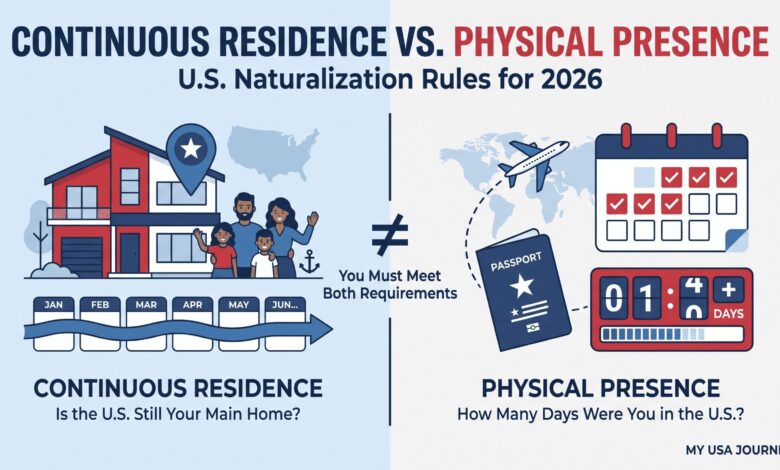
Last verified: July 27, 2026. Continuous residence and physical presence are separate requirements for U.S. naturalization. Continuous residence asks whether the United States remained your principal home over the required period. Physical presence is a mathematical count of the days you were actually in the United States.
A lawful permanent resident can satisfy one requirement and fail the other. Frequent short trips may leave continuous residence intact but reduce the number of U.S. days below the physical-presence minimum. A single long absence can create a continuous-residence problem even when the applicant still has enough total U.S. days.
This guide explains the rules used in ordinary five-year and three-year naturalization cases, how USCIS counts travel days, what happens after an absence of more than six months or one year, and which records can help document your history. For the full process, fees, documents, interview, and oath, read our complete U.S. citizenship through naturalization guide.
This is general educational information, not legal advice. Travel history can also raise questions about abandonment of lawful permanent residence, taxes, employment abroad, or eligibility under a special naturalization provision. Seek advice from a licensed U.S. immigration attorney or a Department of Justice-accredited representative when the facts are complicated.
Continuous residence vs. physical presence at a glance
| Requirement | What USCIS examines | Common five-year route | Qualified three-year spouse route |
|---|---|---|---|
| Continuous residence | Whether the United States remained the applicant’s principal dwelling place during the statutory period | Generally five years immediately before filing, continuing through naturalization | Generally three years immediately before filing, continuing through naturalization |
| Physical presence | The total number of days the applicant was physically inside the United States | At least 30 months, which USCIS describes as at least 913 days, during the five years before filing | At least 18 months during the three years before filing |
| State or USCIS district residence | Where the applicant lived immediately before filing | Generally at least three months | Generally at least three months |
These requirements work together but should never be merged into one calculation. The five-year or three-year clock normally measures continuous residence. The 30-month or 18-month figure measures physical presence. The separate three-month rule concerns residence in the state or USCIS district with jurisdiction over the application.
What continuous residence means for naturalization
USCIS defines residence by reference to a person’s principal actual dwelling place, without regard to intent. In a typical naturalization case, an applicant must show that the United States remained that principal home throughout the applicable statutory period. Keeping a Green Card, a mailing address, or a bank account is relevant but does not automatically prove continuous residence if the applicant was actually living abroad.
For most applicants using the general rule, the statutory period is five years immediately before the N-400 filing date. A qualified spouse of a U.S. citizen applying under the three-year provision normally uses a three-year statutory period. The marriage-based route has additional conditions, including marital union requirements, so the shorter residence period is not available merely because an applicant is married to a citizen.
Continuous residence also remains relevant after filing. An applicant generally must continue residing in the United States from the filing date until admission to citizenship. Travel after filing is not automatically prohibited, but a long absence before the oath can create a new issue. Every trip after filing should be disclosed when USCIS asks for updates at the interview or ceremony.
What physical presence means
Physical presence is more mechanical. USCIS totals the days when the applicant was actually in the United States during the required lookback period. Where the applicant considered home, paid rent, worked remotely, or intended to return does not turn a day spent abroad into a U.S. day.
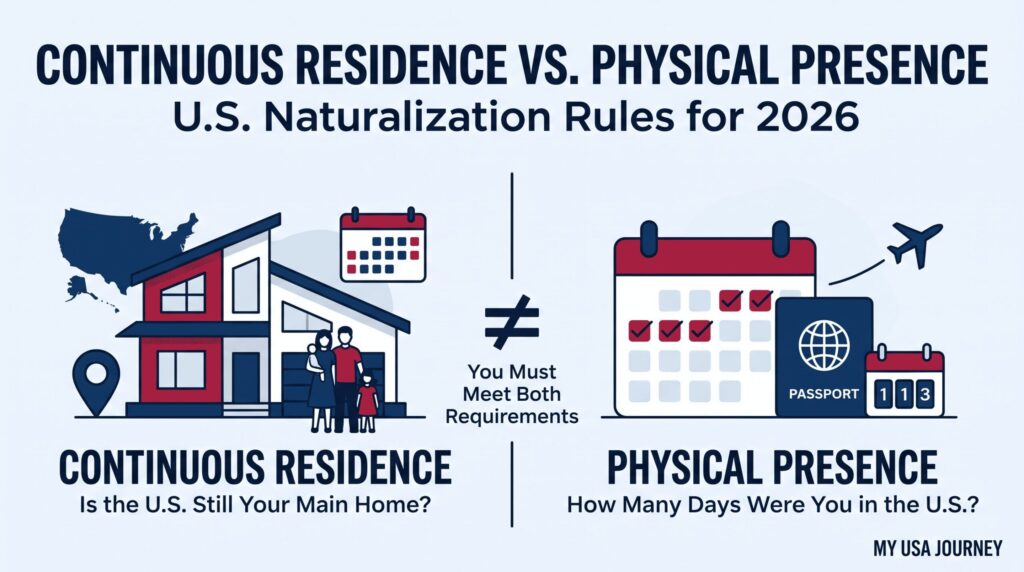
Under the general five-year route, USCIS requires at least 30 months of physical presence during the five years immediately before filing. The USCIS Policy Manual expresses this as at least 913 days. Under the qualified three-year spouse route, the requirement is at least 18 months during the three years immediately before filing.
The safest approach is to calculate exact days, not assume that half of five years equals a rounded month estimate. Leap years, the filing date, and the way departure and return days are counted can affect a close case. Applicants who are near the minimum should verify the calculation carefully before filing.
How USCIS counts departure and return days
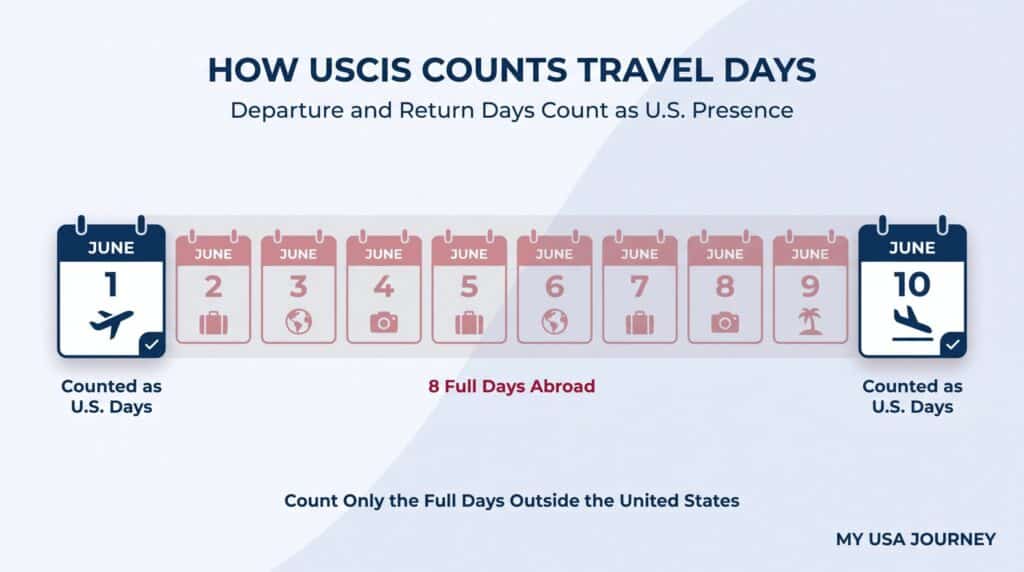
The USCIS Policy Manual states that the day an applicant leaves the United States and the day the applicant returns are counted as days of physical presence in the United States. Only the full intervening days outside the country are counted as days absent for this purpose.
Example: if you depart the United States on June 1 and return on June 10, USCIS counts June 1 and June 10 as U.S. presence days. The eight full intervening days, June 2 through June 9, are days outside the United States.
Form N-400 asks for travel outside the United States during the relevant period. Enter the departure and return dates accurately and keep a separate spreadsheet or calendar showing the day count for each trip. Do not omit weekend trips, cruises, trips to Canada or Mexico, or travel made with a different passport.
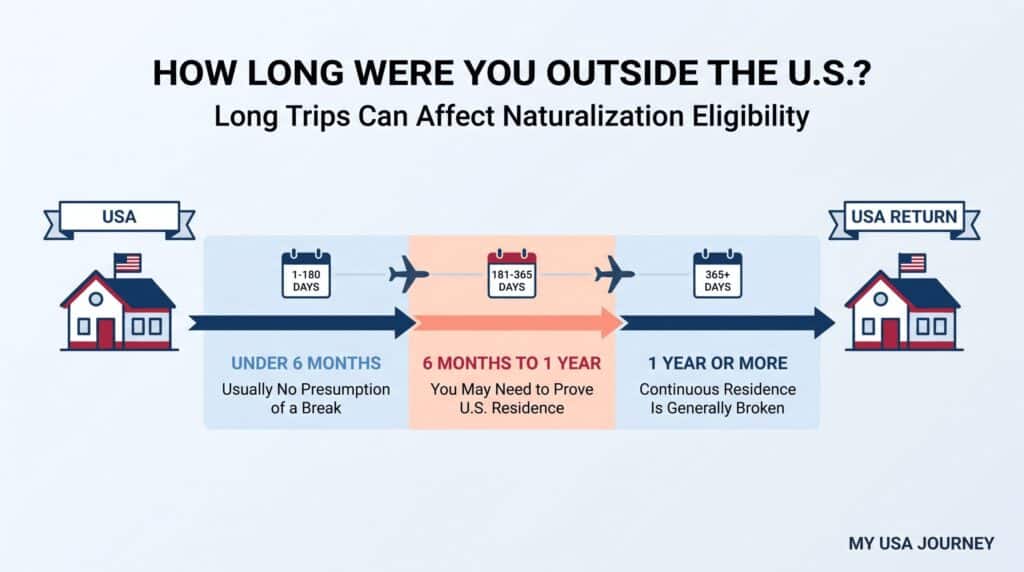
Trips of less than six months
An absence of less than six months ordinarily does not trigger the statutory presumption that continuous residence was broken. That does not mean every short trip is irrelevant. Each trip reduces physical presence, and a pattern of repeated travel may show that the applicant spent most of the statutory period outside the United States.
USCIS may also examine the complete facts when travel patterns suggest that the applicant’s principal actual home was abroad. A person who returns briefly every few months but maintains employment, family life, and a dwelling in another country should not assume that keeping each individual absence below six months solves the problem.
Short trips therefore require two separate checks: first, add every day outside the country to test physical presence; second, review the overall living arrangement to confirm that U.S. residence remained continuous.
Absences of more than six months but less than one year
An absence of more than six months but less than one year creates a rebuttable presumption that continuous residence was interrupted. This is not an automatic denial, but the burden shifts to the applicant to show that the U.S. residence continued despite the extended trip.
USCIS considers the circumstances of the absence and the applicant’s ties to the United States. Helpful evidence may show that the applicant did not terminate U.S. employment, that immediate family members remained in the United States, that the applicant retained full access to a U.S. home, and that the applicant did not obtain employment abroad. No single document guarantees that the presumption will be overcome.
- IRS tax return transcripts showing filing as a resident when legally required
- U.S. employment records, approved leave, payroll records, or a letter explaining a temporary assignment
- A lease, mortgage, property records, utility bills, and evidence that the U.S. home remained available
- School, medical, insurance, vehicle, and banking records showing ongoing U.S. life
- Evidence that a spouse, children, or other immediate family members remained in the United States
- Travel records and documents explaining the temporary purpose and expected duration of the trip
Evidence must be truthful and consistent with the N-400, tax filings, passport stamps, and interview testimony. Filing taxes as a nonresident, claiming a foreign principal residence, or accepting indefinite overseas employment can be especially damaging. Applicants with a trip in this range should prepare the evidence before filing rather than wait for a request from USCIS.
Absences of one year or more
An absence from the United States for a continuous period of one year or more generally breaks continuous residence for naturalization. This rule can apply even if the applicant kept a valid Green Card, obtained a reentry permit, returned without difficulty, or maintained property in the United States. A reentry permit can be important for returning as a permanent resident, but it does not by itself preserve continuous residence for naturalization.
A statutory exception may apply to certain qualifying employment or service abroad, but it must be analyzed separately. Without an exception, the applicant normally must establish a new period of continuous residence after returning to the United States.
The 4-year-and-1-day and 2-year-and-1-day rules
The phrases 4 years and 1 day and 2 years and 1 day are often treated online as automatic filing dates after a long absence. The actual USCIS framework is more careful. A general five-year applicant who returns after an absence of one year or more may reach a point 4 years and 1 day later when the earlier absence inside the new statutory window is less than one year. However, it is still more than six months, so the applicant must overcome the presumption that continuous residence was broken.
For a qualified three-year spouse applicant, the comparable point is 2 years and 1 day after return, again with the need to overcome the presumption. Waiting 4 years and 6 months under the five-year route, or 2 years and 6 months under the three-year route, generally moves the prior absence below six months within the applicable lookback period. The correct date depends on the exact travel dates, the eligibility provision, and whether all other requirements are met.
| Naturalization basis | Earlier possible point after return | Important consequence | Later point commonly used |
|---|---|---|---|
| General five-year route | 4 years and 1 day | The remaining portion of the old absence may still exceed six months, so the presumption must be rebutted | 4 years and 6 months |
| Qualified three-year spouse route | 2 years and 1 day | The remaining portion of the old absence may still exceed six months, so the presumption must be rebutted | 2 years and 6 months |
These dates are not a substitute for a case-specific calculation. A person may still lack enough physical-presence days, may no longer qualify for the three-year spouse route, or may have a separate issue with lawful permanent resident status. Legal review is prudent before relying on an earlier date.
Can Form N-470 preserve continuous residence?
Form N-470, Application to Preserve Residence for Naturalization Purposes, is available only in defined situations. It is not a general permission for any permanent resident to live abroad without affecting naturalization. Qualifying categories can include certain employment by the U.S. government, a recognized American institution of research, an American firm engaged in foreign trade or commerce, certain public international organizations, and certain religious duties.
USCIS states that, in general, the applicant must have been physically present in the United States as a lawful permanent resident for an uninterrupted period of at least one year before the qualifying work abroad. Timing and category-specific exceptions matter. Approval can preserve continuous residence, but it does not automatically preserve the separate physical-presence requirement unless a specific law provides that benefit.
Review the current USCIS Form N-470 page and the applicable policy before departure. Do not assume that filing after a long absence has already started will repair a break.
The 90-day early filing rule
Certain applicants under the five-year or three-year continuous-residence provisions may file Form N-400 up to 90 calendar days before completing the required residence period. This is a filing allowance, not a reduction of every naturalization requirement.
The applicant must still satisfy the other requirements at the required time, including the applicable physical-presence minimum. Use the official USCIS early filing calculator because 90 calendar days is not the same as subtracting three calendar months. Filing even one day too early can lead to rejection or denial.
How to build an accurate travel history
Travel calculations are strongest when built from several independent records. Passport stamps alone may be incomplete, especially for land crossings, cruises, automated gates, or travel with multiple passports. Start with the N-400 lookback period and reconcile every source before signing the application.
- Set the exact statutory window. Work backward from the planned N-400 filing date using the correct five-year or three-year provision.
- List every departure and return. Include short trips, land crossings, cruises, and travel after becoming a permanent resident that falls inside the requested history.
- Collect records. Review current and expired passports, airline emails, boarding passes, calendar entries, credit-card activity, employer records, and available government travel history.
- Count full days abroad. Treat the departure and return dates as U.S. days under the USCIS counting rule, then total the intervening days.
- Flag extended absences. Mark every trip approaching six months and every trip of one year or more for a separate continuous-residence analysis.
- Recalculate before filing. A new trip or a delayed filing date changes the lookback window and may change both totals.
Keep the worksheet with the complete copy of the filed N-400. Bring updated travel information to the interview because USCIS may ask about trips taken after filing. If records conflict, correct the discrepancy truthfully rather than force the dates to match an estimate.
Worked example: enough residence, not enough presence
Assume a five-year applicant maintained a genuine U.S. home and had no individual absence of six months or more. During the five-year window, the applicant nevertheless spent a total of 960 full days abroad through many shorter trips. The travel pattern may not trigger the six-month presumption for any single trip, but the applicant has only about 866 days physically present in a standard 1,826-day five-year window. That is below the USCIS minimum of 913 days.
The applicant should not file merely because five years have passed since becoming a permanent resident. Waiting can move older travel days outside the lookback window and add new U.S. days, but the exact filing date must be recalculated.
Worked example: enough presence, possible residence break
Assume another five-year applicant was physically in the United States for well over 913 days but took one trip abroad lasting eight months. The physical-presence total may be sufficient. The eight-month absence still creates a rebuttable presumption that continuous residence was interrupted.
That applicant must address why the trip was temporary and present credible evidence of continued U.S. residence. A high day count does not eliminate the continuous-residence issue. This is the practical reason the two tests must be calculated separately.
Travel after filing Form N-400
Physical presence is generally measured during the statutory period before filing, but continuous residence continues through naturalization. Applicants may travel after filing, yet they should avoid assuming that the pending N-400 protects them from the consequences of a long absence.
Bring all passports and travel documents requested in the interview notice. Update the officer about post-filing travel and any change of address, employment, or family circumstances. Before studying for the interview, confirm which civics version applies in our guide to the 2025 U.S. civics test and its 128 questions.
Common mistakes that cause travel problems
- Treating continuous residence and physical presence as two names for the same requirement
- Assuming every trip under six months is automatically harmless
- Counting only passport stamps and forgetting land crossings, cruises, or a second passport
- Using months instead of exact days when the physical-presence total is close
- Assuming a reentry permit preserves continuous residence for naturalization
- Believing 4 years and 1 day or 2 years and 1 day always guarantees eligibility
- Filing 90 days early before meeting the separate physical-presence requirement
- Failing to disclose travel taken after filing but before the interview or oath
- Submitting tax, employment, housing, and travel records that tell inconsistent stories
- Relying on Form N-470 without confirming qualifying employment and timing requirements
When legal advice is especially important
A professional review is especially useful after an absence of more than six months, any absence of one year or more, repeated extended travel, foreign employment, nonresident tax filings, or uncertainty about abandonment of permanent residence. Advice is also important when the applicant was questioned at the border, signed Form I-407, received a notice to appear, or may need Form N-470.
Only a licensed attorney or a Department of Justice-accredited representative can provide authorized immigration legal advice. A notario, travel agent, tax preparer, or form-filling service should not decide whether an absence broke residence.
Official resources
- USCIS Policy Manual: Continuous Residence
- USCIS Policy Manual: Physical Presence
- USCIS Policy Manual: Modifications and Exceptions
- USCIS Policy Manual: Jurisdiction, Residence, and Early Filing
- USCIS Form N-400 page
- USCIS Form N-470 page
Continuous residence and physical presence FAQ
Are continuous residence and physical presence the same?
No. Continuous residence examines whether the United States remained your principal dwelling place during the statutory period. Physical presence counts the days you were actually inside the United States. You must satisfy both requirements.
How many days of physical presence are required for the five-year rule?
USCIS requires at least 30 months of physical presence during the five years immediately before filing and describes this as at least 913 days. Applicants near the minimum should calculate exact days rather than rely on a rough month estimate.
How much physical presence is required under the three-year spouse rule?
A qualified applicant using the three-year provision generally needs at least 18 months of physical presence during the three years immediately before filing. The applicant must also satisfy all marriage-based eligibility conditions.
Does a trip of less than six months break continuous residence?
A trip of less than six months ordinarily does not trigger the statutory presumption of a break, but it still reduces physical presence. Repeated trips can also cause USCIS to examine whether the applicant’s principal actual home was really in the United States.
What happens after a trip of more than six months but less than one year?
The trip creates a rebuttable presumption that continuous residence was interrupted. The applicant may present credible evidence of continuing U.S. employment, family, housing, tax treatment, and other ties, but no single document guarantees approval.
Does an absence of one year automatically break continuous residence?
An absence of one continuous year or more generally breaks continuous residence for naturalization unless a specific statutory exception applies. A Green Card or reentry permit does not by itself preserve continuous residence.
What is the 4-year-and-1-day rule?
After returning from an absence of one year or more, a general five-year applicant may reach an earlier filing point at 4 years and 1 day. However, the remaining part of the old absence can still exceed six months, so the applicant must overcome the presumption of a break. It is not an automatic approval rule.
What is the 2-year-and-1-day rule?
It is the comparable framework for a qualified applicant using the three-year spouse provision after an absence of one year or more. The applicant may still need to rebut the presumption of a break and must continue to qualify under the marriage-based rule.
Do departure and return days count as days in the United States?
Yes. USCIS counts the day you depart and the day you return as days of physical presence in the United States. The full intervening days are counted as days abroad.
Does a reentry permit protect naturalization eligibility?
Not automatically. A reentry permit can help a permanent resident seek admission after extended travel, but it does not by itself preserve continuous residence for naturalization. Form N-470 or another specific exception may be required when available.
Can I use the 90-day early filing rule if I lack enough U.S. days?
No. The 90-day rule permits certain applicants to file before completing the full continuous-residence period. It does not excuse the separate physical-presence requirement or other eligibility rules.
What evidence should I keep for an extended trip?
Keep passports, travel records, tax transcripts, employment and leave records, housing documents, family evidence, financial records, and documents explaining the temporary purpose of the trip. The evidence should be truthful and consistent across the N-400 and interview.
Final checklist before filing
- Identify the correct five-year, three-year, or special naturalization provision
- Set the exact statutory window based on the planned filing date
- List and verify every departure and return date
- Calculate physical-presence days using the USCIS counting rule
- Flag every absence of more than six months and every absence of one year or more
- Gather evidence before filing if a presumption of interrupted residence may apply
- Confirm that post-filing travel will not create a new continuous-residence problem
- Use the current N-400 instructions and official USCIS early filing calculator
- Get authorized legal advice when travel, taxes, employment abroad, or permanent resident status is uncertain
A successful naturalization travel analysis answers two different questions: did the United States remain your principal home, and were you physically inside the country for enough days? Calculate both before filing, preserve the records behind your dates, and recheck current USCIS guidance whenever your filing date or travel plans change.